
Complete Home Composting Guide
Learn how to transform your organic waste into the best natural fertilizer for your plants. A sustainable, economical practice essential for organic gardening.
What is composting and why should you start today?
Composting is a natural process of decomposing organic matter (like food scraps and yard waste) that transforms into a nutrient-rich material called compost. Making home compost not only drastically reduces the amount of trash we send to landfills, but also provides a free and high-quality fertilizer for your organic garden.
Benefits of Home Compost
- Improves soil structure: Helps retain moisture in sandy soils and improves drainage in clay soils.
- Provides essential nutrients: Releases nitrogen, phosphorus, and potassium slowly and naturally.
- Promotes biodiversity: Attracts earthworms and beneficial microorganisms that prevent plant diseases.
- Reduces your carbon footprint: Less organic waste in landfills means fewer methane emissions.
The Golden Rule: Green and Brown Materials
The secret to good home composting without bad odors lies in balance. You need a proper mix of nitrogen-rich (green) and carbon-rich (brown) materials.
Green Materials (Nitrogen)
- Fruit and vegetable scraps
- Coffee grounds and tea bags
- Fresh grass clippings
- Crushed eggshells
- Green pruning waste
Brown Materials (Carbon)
- Dry leaves
- Crushed dry branches
- Ink-free cardboard (egg cartons)
- Newspaper
- Straw or hay
Step-by-step to make your compost
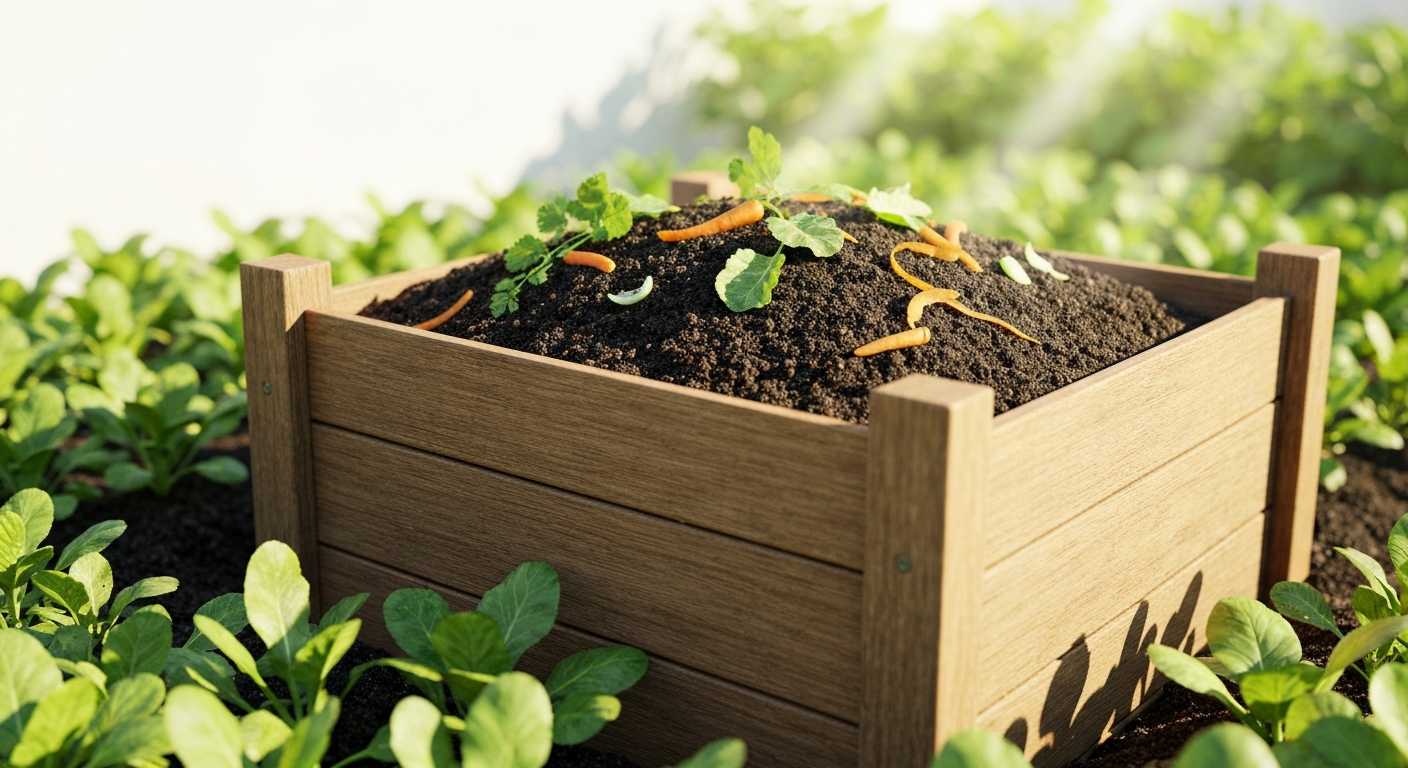
- Choose the location and container: You can use a commercial composter, make one with pallets, or if you have little space, use a vermicomposter (with worms) on the balcony. It should be in a place with partial shade.
- Create the base: Put a layer of about 10-15 cm of coarse brown material (dry branches) at the bottom to ensure good drainage and aeration.
- Add the layers (Lasagna Effect): Alternate layers of green and brown materials. Try to maintain a ratio of 2 parts brown to 1 part green.
- Maintain moisture: The compost should be moist like a wrung-out sponge, but not soaked. If it's very dry, water it lightly. If it's very wet, add more brown material.
- Oxygenate the mix: Turn the compost with a pitchfork or aerator every 1-2 weeks. Oxygen is vital for microorganisms to work and prevent bad odors.
What you should NEVER put in the compost
To avoid pests, bad odors, and pathogens, strictly avoid:
- Meat, fish, or bones.
- Dairy or fats (oil).
- Dog or cat feces.
- Diseased plants or weeds with seeds.
- Coal ashes or treated woods.
If in doubt about the origin of the material, it is better not to add it to the compost.