

What is
Permaculture?
On this page you will learn what it is about.
Designing with nature
Permaculture is a design tool that invites us to deeply observe each place before intervening. Inspired by the patterns of nature, it seeks to create human habitats that are more fertile, efficient and capable of sustaining themselves better over time. It was born in Australia in the 70s, driven by Bill Mollison and David Holmgren, from the idea of "permanent agriculture" and, later, "permanent culture". Today permaculture is present all over the world, with millions of people studying, practicing or adapting it to their territories. Its proposal is not limited to growing food. It also helps us observe how we live, how we use energy, water, soil, resources and the relationships that sustain our daily lives. From its ethics and principles, permaculture allows designing more resilient and coherent systems with the place: gardens, orchards, farms, communities and ways of life capable of sustaining themselves better over time. In Organic Agro-Gardening we do not understand permaculture as a closed recipe, but as a practical look: observe before acting, work with nature, not against it, and accompany each person to make more conscious decisions about the space they inhabit, care for or want to transform.
What Does «Permaculture» Mean?
The term "permaculture" combines the words permanent and culture. It was coined in the 1970s by Bill Mollison and David Holmgren, who developed a system based on the principles of natural ecosystems to create sustainable societies.
Fundamental Ethics of Permaculture
The Three Ethics that Guide Permaculture
1. Earth Care
- Protect and regenerate soil, water, plants and all living beings.
- Respect natural cycles to ensure the sustainability of ecosystems.
2. People Care
- Meet people's basic needs in a sustainable way.
- Ensure that food, shelter, education and work are aligned with respect for the environment.
3. Fair Share
- Distribute surpluses and resources fairly.
- Avoid excessive consumption and promote universal access to what is necessary.
Design Principles
Designing with Natural Intelligence
Permaculture is based on design principles that seek to harness and enhance available resources while minimizing negative impacts. These include:
Observe and Interact: Understand the environment before intervening.
Catch and Store Energy: Harness resources like rainwater and sunlight.
Obtain a Yield: Design systems that offer tangible benefits.
Apply Self-Regulation and Accept Feedback: Create self-sufficient and resilient systems.
Use and Value Renewable Resources and Services: Prioritize local and renewable resources.
Produce No Waste: Promote reuse and recycling.
Design from Patterns to Details: Identify natural patterns and apply them to design.
Integrate Rather than Segregate: Promote collaboration among system elements.
Use Small and Slow Solutions: Respect natural timing and opt for gradual changes.
Use and Value Diversity: Harness biodiversity to improve system resilience.
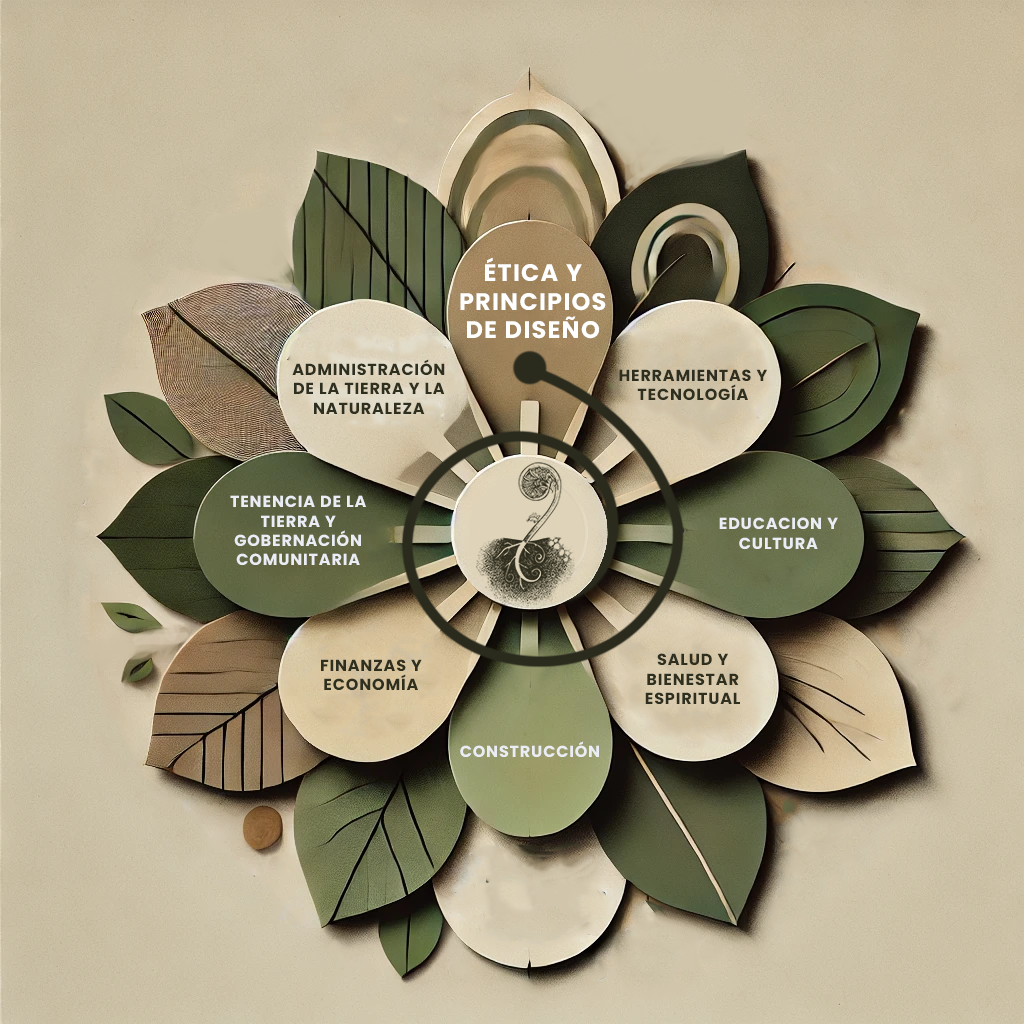
The Permaculture Flower:
A Comprehensive Model for Sustainability
The permaculture journey begins with Ethics and Design Principles, and progresses through key stages that enable the creation of a sustainable future. These stages are connected by an evolutionary path that encompasses the personal, the collective, and the global.
Key Areas of Permaculture
1. Land and Nature Stewardship
- Bio-intensive gardens.
- Food forests.
- Seed saving.
- Organic agriculture.
- Biodynamic agriculture.
- Natural agriculture.
- Keyline water harvesting.
- Holistic pasture management.
- Natural sequence farming.
- Agroforestry.
- Nature-based forestry.
- Integrated aquaculture.
- Hunting and gathering.
- Gleaning/recovering discarded food.
Applications of Permaculture
How to Put Permaculture into Practice
Permaculture has practical applications in multiple areas, including:
- Agriculture and Livestock:
- Creation of sustainable agricultural systems that mimic the biodiversity of natural ecosystems.
- Gardening:
- Design of organic gardens and orchards that integrate native plants and ecological techniques.
- Building:
- Use of natural materials and sustainable building methods.
- Water Management:
- Rainwater harvesting and storage.
- Design of ponds and wastewater treatment systems.
- Economy and Community:
- Development of local communities and self-sufficient economic systems.
- Personal Resilience:
- Taking responsibility for our impact on the planet.
In short, permaculture is a philosophy of life and a design methodology that seeks to create sustainable and harmonious systems with nature, improving the quality of life of people and the planet.
Why Practice Permaculture?
Benefits for You and the Planet
- Promotes self-sufficiency and reduces dependence on external systems.
- Helps regenerate damaged ecosystems.
- Promotes a respectful and collaborative relationship with the natural environment.
- Offers practical solutions to face challenges such as climate change and resource scarcity.

Want to apply permaculture to your garden, orchard or farm?
We can accompany you from the initial observation to the design and care of your space. Tell us where you are and where you want to start.